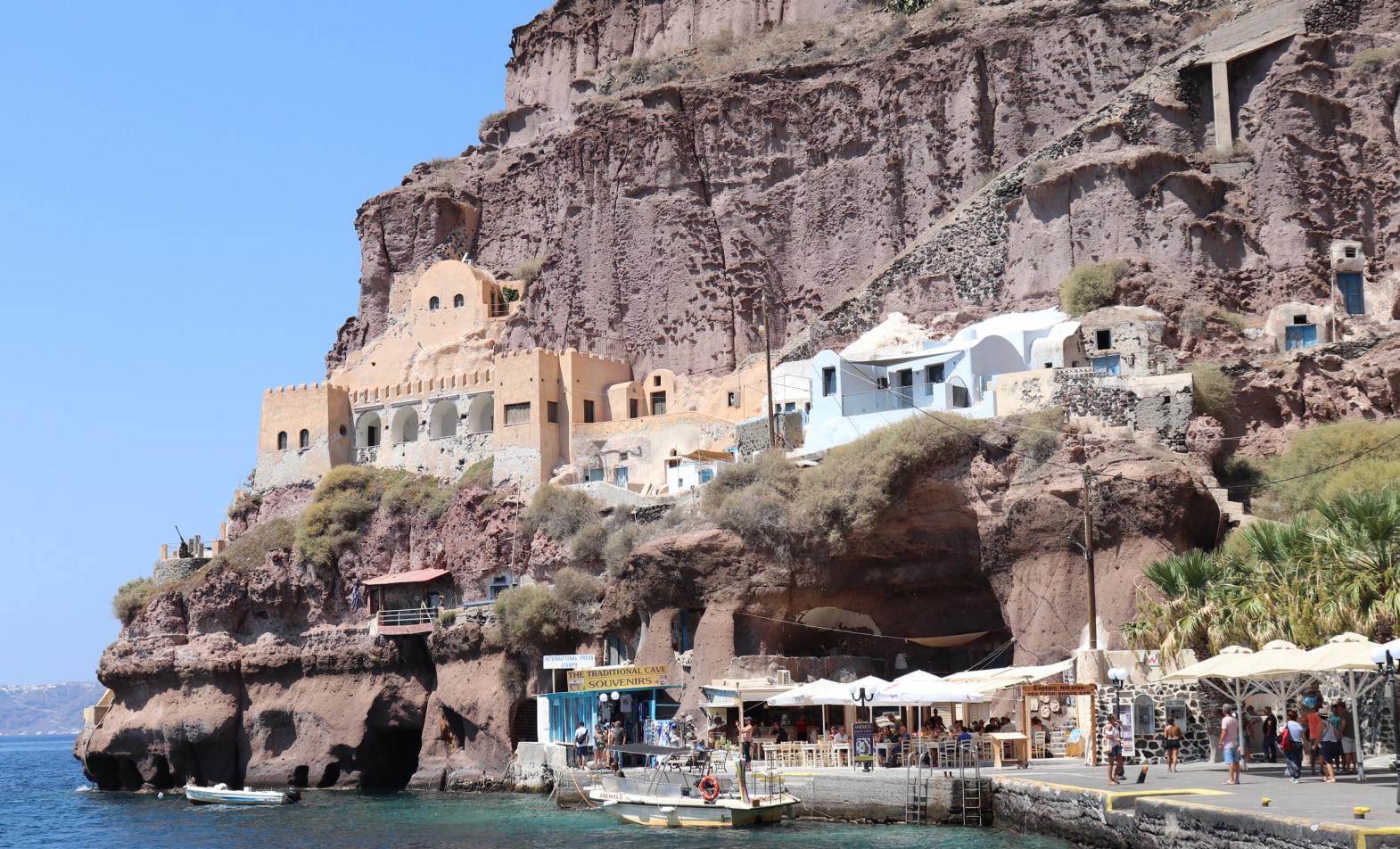

Looking for the best things to do in Santorini? This guide covers top villages, hidden gems in Santorini, sunset spots in Oia, hidden beaches in Santorini Greece, and unmissable Santorini highlights put together by people who live and cook on the island.
Santorini is what a volcano leaves behind. Around 3,600 years ago, one of the largest eruptions in human history blew the centre out of the island, and the sea poured into the hollow it left. What remained is the crescent you see today: a ring of cliffs standing as high as 300 metres above a drowned crater, with whitewashed villages clinging to the rim.
This guide runs through the places worth your time, the villages, the beaches, the viewpoints and a few corners most visitors walk past, put together by people who live and cook on the island rather than pass through it. For practical planning, the island’s official visitor information is a useful companion to what follows.
Villages and Towns
Santorini Sunset Spots Oia
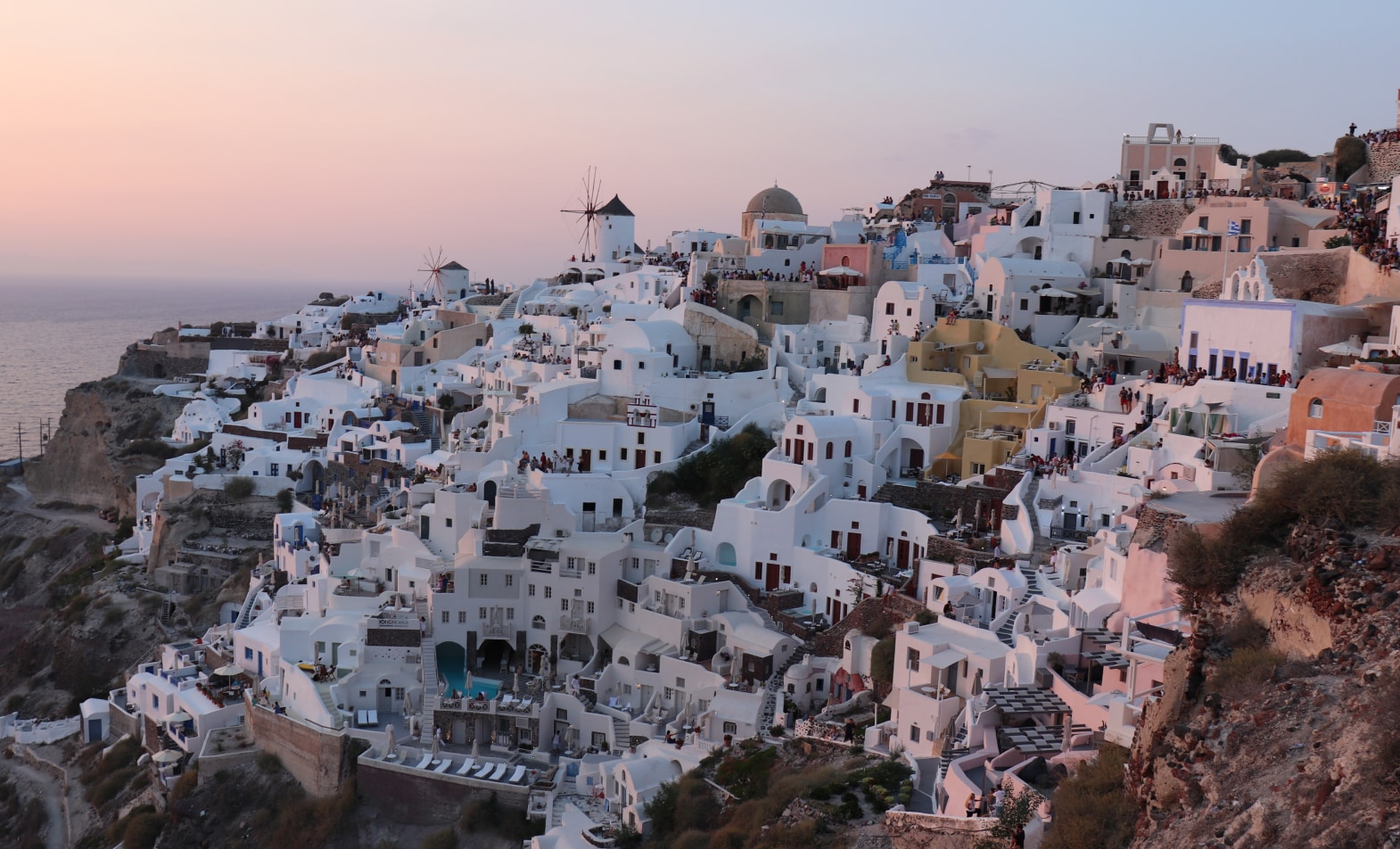
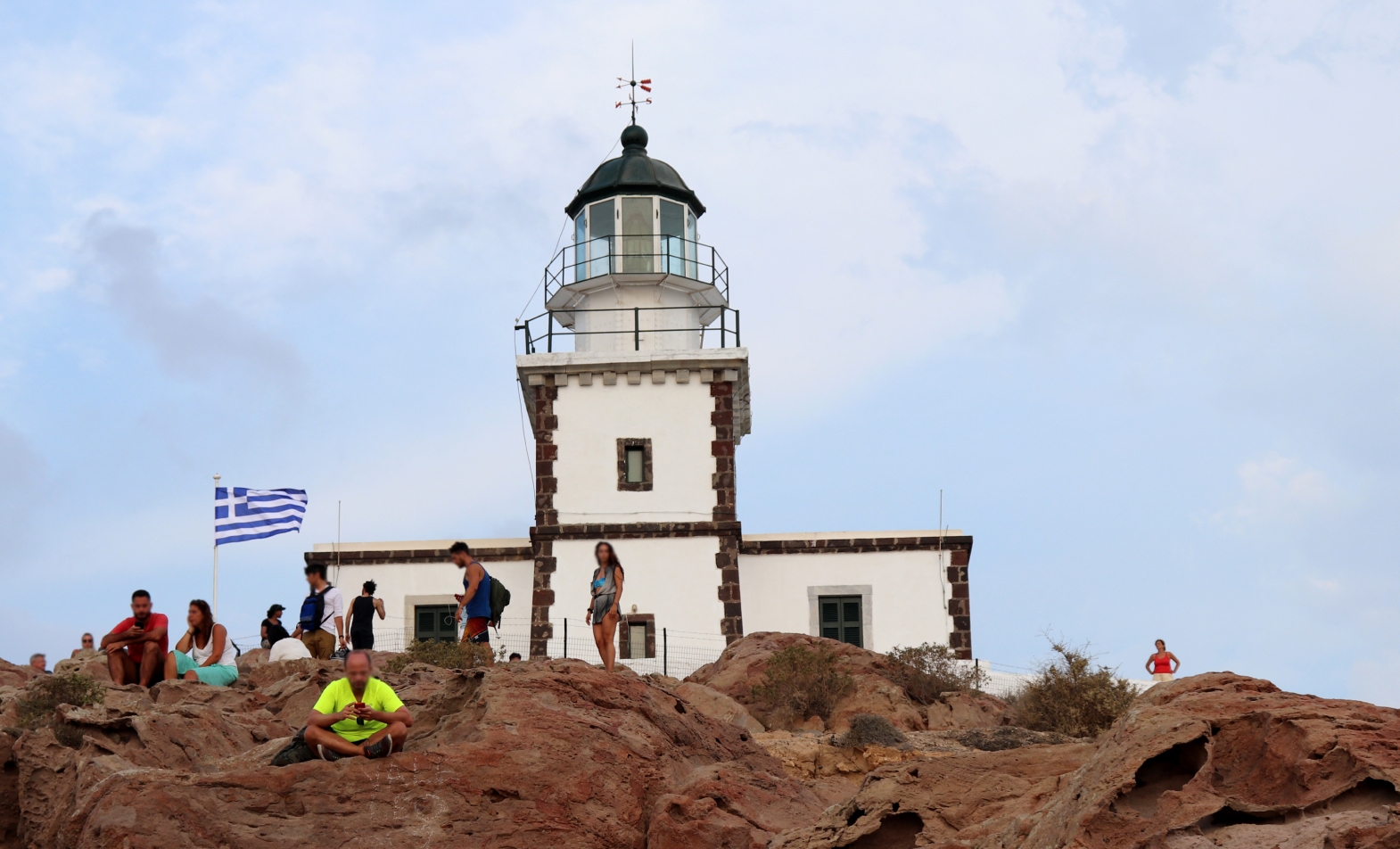
Oia is the island’s iconic spot for watching the sun sink into the caldera, and for good reason. The western-facing cliff gives an unbroken view as the light turns the water copper and gold. The Kasteli at the village’s western tip draws the largest crowd, but the caldera path just below the main street offers the same view with more room to breathe. For a quieter alternative, the Akrotiri Lighthouse on the south-western cape catches the sun dropping over open sea, no crowd, no jostling, just the sky changing colour above the Aegean. Time your dinner in Oia to coincide with dusk and you get both the sunset and the afterglow from a table.
Oia
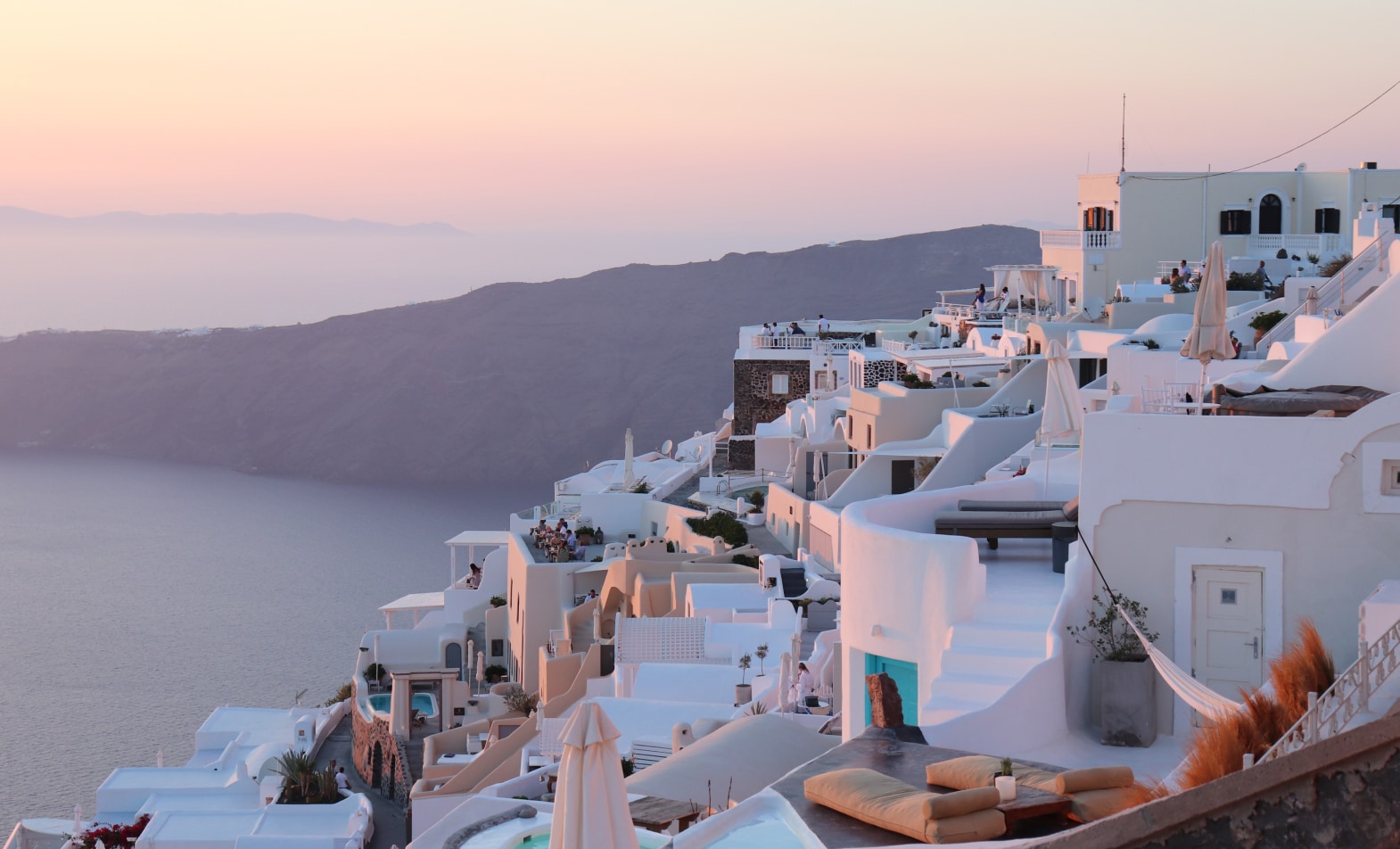
Oia sits on the northern tip, and it is the image most people carry of Santorini: white houses and blue domes stacked down the cliff, with the old Byzantine castle (the Kasteli) at the far end where the crowd gathers each evening for the sunset. Below the village, a few hundred steps wind down the kalderimia, the old cobbled paths, to the little harbour of Ammoudi. Oia is also where you will find some of the island’s finest restaurants, the kind of place to settle in for a long dinner as the sun drops into the caldera beside someone you love.
Fira
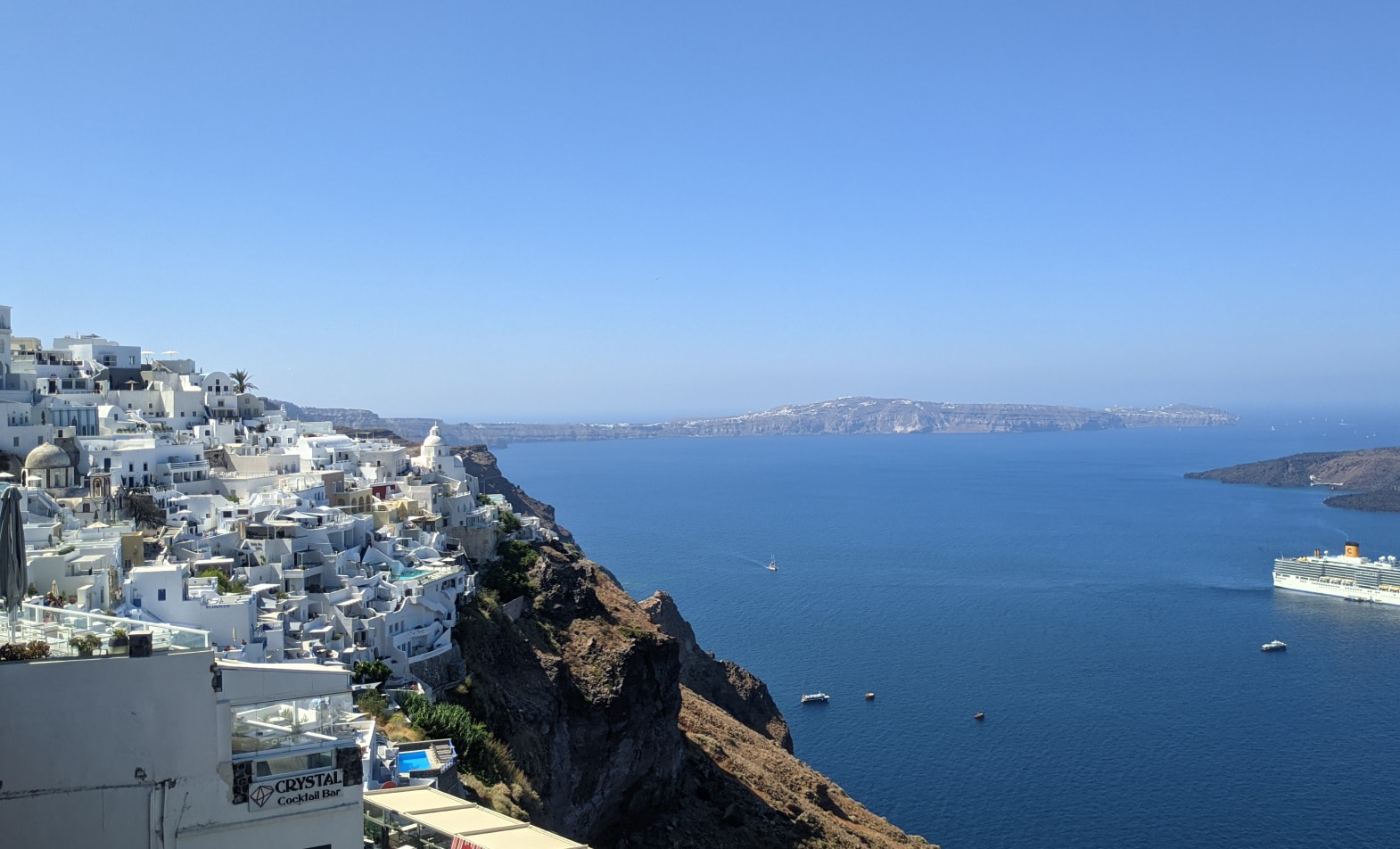
Fira is the capital and the island’s busy heart, running along the caldera edge a few kilometres south of Oia. It holds the museums worth seeing, the Museum of Prehistoric Thera with its finds from Akrotiri among them, along with the cable car down to the old port and most of the island’s nightlife. By day it is shops and caldera-view cafés; after dark the bars along the marble lanes fill up.
Imerovigli
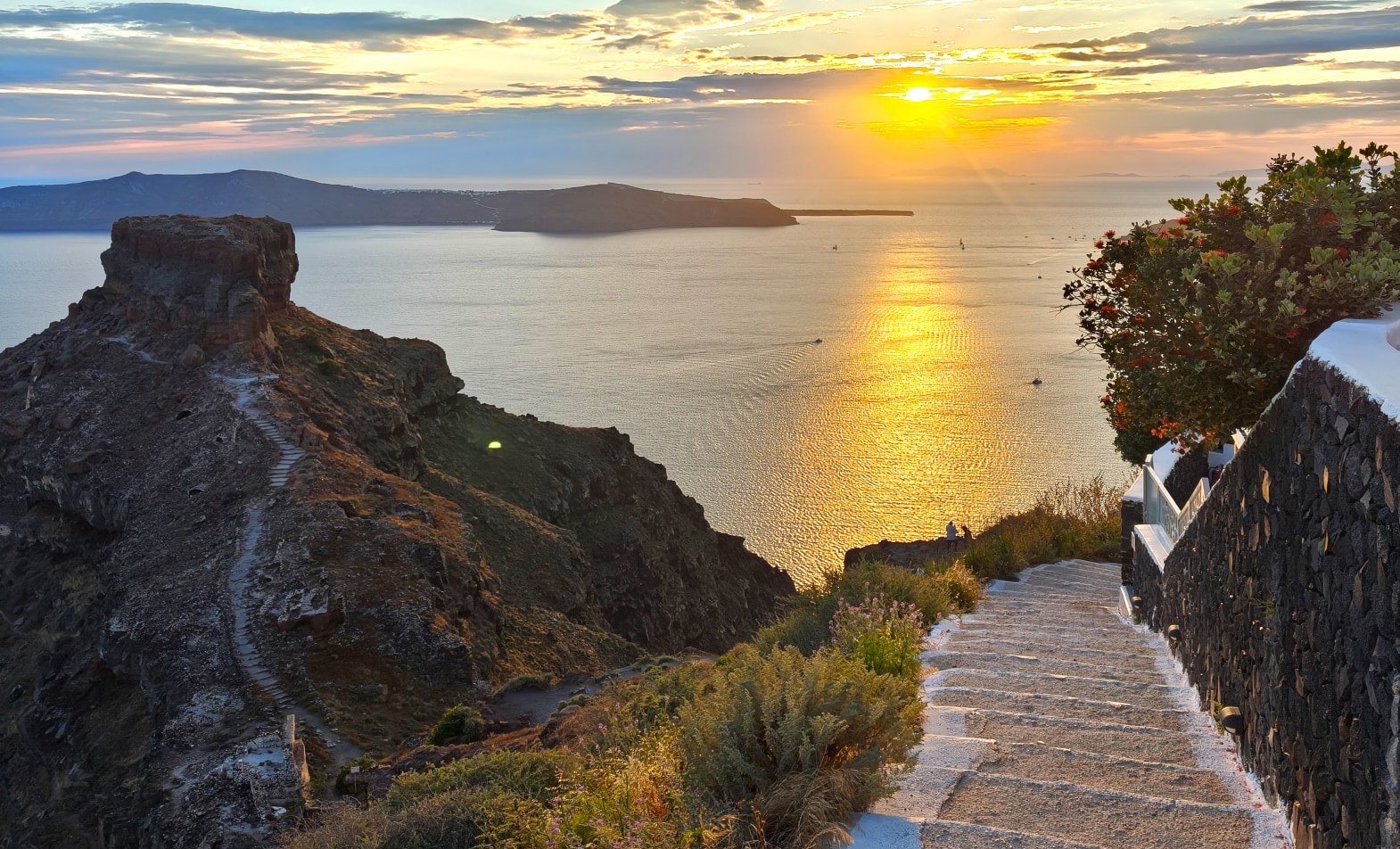
Imerovigli sits at the highest point of the caldera rim, between Fira and Oia, which is why locals call it the balcony of the caldera. It is quieter and more residential than its neighbours, and it looks straight out at Skaros Rock, the great promontory that was once the island’s medieval capital. The short walk out to Skaros is among the best on the island.
Pyrgos
Pyrgos is the old capital and the highest of the traditional villages, a maze of white houses spiralling up to a Venetian Kasteli at the top. From the castle you get a rare 360-degree view of the whole island, sea on every side. It sits in the heart of the wine country, with several of Santorini’s best wineries a short drive away, and far fewer crowds than the caldera towns.
Emporio
Emporio is the largest village on the island and one of the least visited, which is part of its charm. At its centre is the Kasteli, a fortified medieval quarter built as a single defensive block against pirates, with houses turned inward and alleys that still twist like a puzzle. It rewards an unhurried wander far more than a quick stop.
Megalochori
Megalochori is a small working village that has held onto its character: stone arches, hidden courtyards and tall bell towers rising over the rooftops. It is another centre of the wine trade, with historic cellars and tasting rooms tucked between the houses, and a quiet square or two where the pace stays local.
Akrotiri
Akrotiri, on the south of the island, gives its name to the archaeological site beside it: a Bronze Age town buried under volcanic ash in the same eruption that shaped the caldera, and so well preserved that it is often called the Minoan Pompeii. The frescoes and multi-storey buildings show just how advanced the settlement was before the ash fell.
Finikia
Finikia is a tiny traditional settlement a few minutes inland from Oia, and it shows what the area looked like before tourism arrived. A handful of restored cave houses, a couple of small tavernas and almost no traffic make it a calm counterpoint to its famous neighbour, and it is an easy walk away.
Hidden Beaches in Santorini Greece
Perissa and Perivolos
Perissa and Perivolos form one long stretch of black volcanic sand on the southeast coast, several kilometres of it, backed by the towering rock of Mesa Vouno. This is the island’s beach-bar country: organised loungers, music, water sports and tavernas running almost end to end, with Perivolos the slightly more upmarket half.
Kamari
Kamari is the other big black-sand beach, well organised and family-friendly, with a paved promenade of restaurants and bars behind it. Above it rises Mesa Vouno and the ruins of Ancient Thera, the island’s Greek and Roman city, reached by a winding road or a steep footpath straight up from the sand.
Red beach
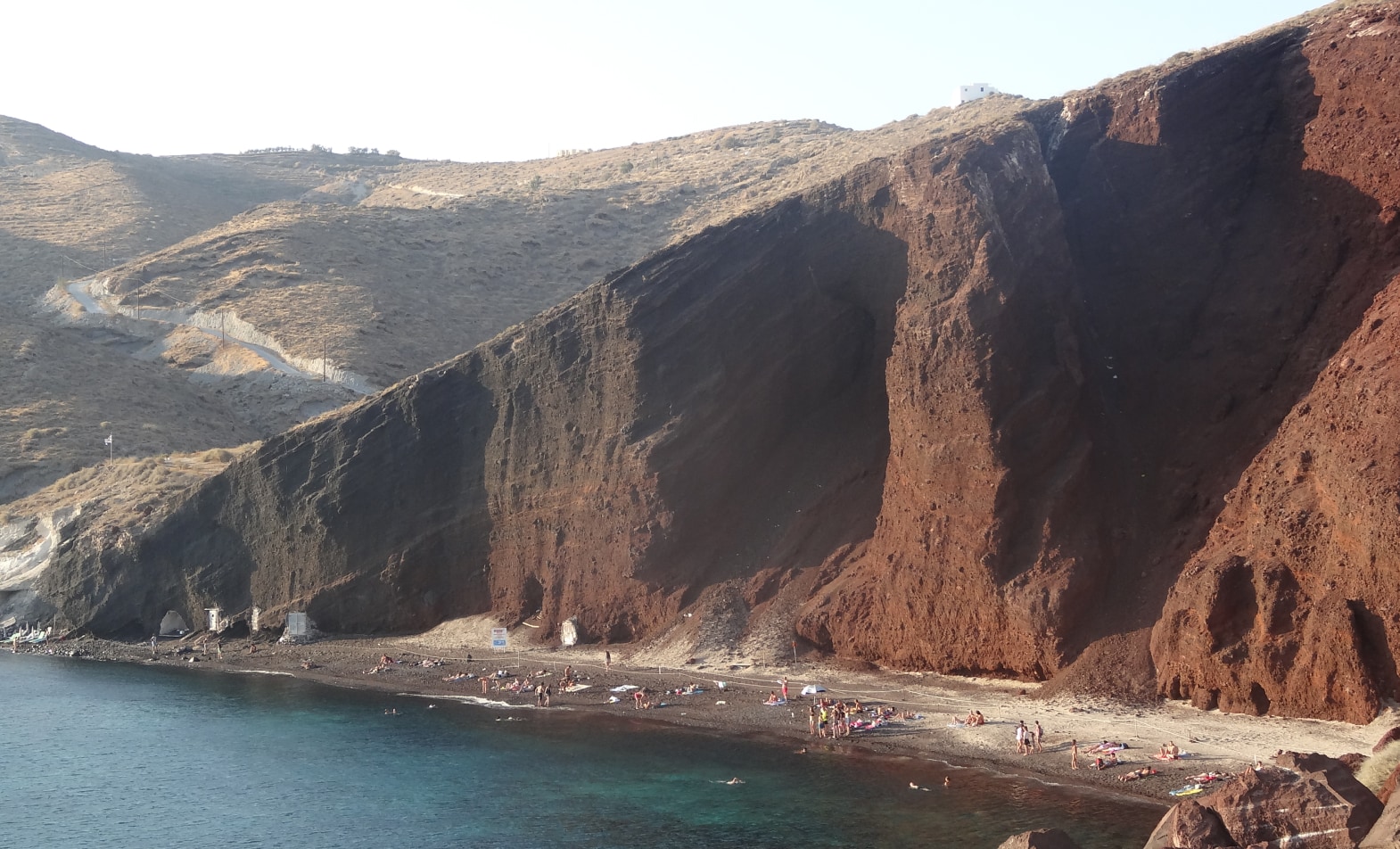
Red Beach, near Akrotiri, is the island’s most photographed shore, a small cove framed by sheer cliffs of deep rust-red rock. The colour comes from iron in the volcanic stone slowly rusting in the open air, the same chemistry as metal left out in the rain. A short, rough scramble leads down to it. The cliffs do shed rock, so keep to the marked areas and take care.
White beach
White Beach lies just around the headland from Red Beach, below pale cliffs of volcanic ash that give it its name. There is no road in: you reach it by small boat from Akrotiri, or on foot over the rocks from Red Beach, which is exactly why it stays calm even in August.
Vlychada
Vlychada, on the south coast, is the strangest and quietest of the lot. Wind has carved the soft white-grey cliffs behind it into smooth, folded shapes closer to a moonscape than a beach, and the crowds thin the further along you walk. The little marina here is one of the prettier corners of the south.
Ammoydi
Ammoudi is the small fishing harbour directly below Oia, reached by around 300 steps down from the village or a short drive round. The water is deep and clear for swimming straight off the rocks, there is a spot the brave use for cliff jumping, and the row of harbour tavernas serves some of the freshest fish on the island as the light fades.
Baxedes
Baxedes, on the north coast near Oia, is where locals go to escape the caldera crowds. It is an unorganised stretch of dark sand and pebbles with a couple of tavernas and a wilder, open-sea feel. It can catch the wind, but on a calm day it is one of the most relaxed swims close to Oia.
Must see spots – Five Caldera Viewpoints
The caldera is the reason to come, and you can read it from several points along the rim. These five give the widest sweep (coordinates are approximate, handy for dropping a pin):
• Oia Castle (Kasteli) — the classic sunset stage at the village’s western tip. 36.462° N, 25.375° E
• Imerovigli, by Skaros Rock — the highest stretch of the rim, looking straight down the caldera. 36.433° N, 25.417° E
• Firostefani, at the Three Bells — a quieter balcony just north of Fira. 36.424° N, 25.426° E
• Fira caldera promenade — the cable-car edge, with the volcano dead ahead. 36.417° N, 25.432° E
• Profitis Ilias summit — the island’s roof, a true 360-degree view. 36.378° N, 25.452° E
The Volcanic Islands and Hot Springs
In the middle of the caldera float the two black islets of Nea Kameni and Palea Kameni, the still-active heart of the volcano. Boats from the old port of Fira and from Ammoudi run out to them: on Nea Kameni you can walk up to the steaming craters, and off Palea Kameni you can swim in the warm, sulphur-tinted water of the hot springs. Several local boat operators run these half-day trips.
Akrotiri Lighthouse
Out on the south-western cape stands the Akrotiri lighthouse, one of the oldest in Greece and one of the very few sunset spots with no crowd at all. Here the sun goes down over open sea rather than the caldera, which makes for a calmer, more private evening than Oia.
Profitis Ilias Monastery
Profitis Ilias is the highest point on the island at 567 metres, crowned by an 18th-century monastery. The view is the real draw: the whole of Santorini below you, Anafi off to the east, Ios and Sikinos to the north-west, and on a clear day the mountains of Crete more than 100 kilometres to the south.
The Fira to Oia Walk
The walk from Fira to Oia is the single best thing many visitors do here. It follows the caldera rim for about 10 kilometres, three to four hours at a gentle pace, through Firostefani and Imerovigli, with the drop to the sea on your left the whole way. Go early or late to miss the heat, wear proper shoes for the gravel sections, and time it to reach Oia before sunset. The full route and trail map are worth a look before you set off.
Hidden gems – The Skaros rock hike
Skaros Rock looks like nothing more than a bare promontory below Imerovigli, but it was the capital of Santorini until the 18th century, a fortified town of more than two hundred houses that repeated earthquakes finally emptied. A marked path drops down from the church of Agios Georgios and out onto the rock, around 20 to 30 minutes each way, ending at a tiny chapel with the caldera wrapped around you on three sides.
Thirasia Island
Thirassia is the small inhabited island on the far side of the caldera, a piece of Santorini that broke away and kept the slow pace the main island had fifty years ago. Day boats cross from the old port and from Ammoudi. There are a couple of villages, a few tavernas, almost no cars, and a view back at Santorini you cannot get from anywhere else.
Mesa Pigadia Cave Houses
Mesa Pigadia, on the quiet south coast below Akrotiri, is a black-sand cove backed by old fishermen’s cave houses cut straight into the soft cliff, some now restored as places to stay. A dirt road or a boat from Akrotiri gets you there, the swimming is clear, and a single taverna keeps it from feeling deserted. There is more on it among the island’s lesser-known beaches.
The Kasteli of Emporio
Worth singling out on its own: the Kasteli at the centre of Emporio is one of the best-kept medieval quarters in the Cyclades, a windowless outer ring of houses enclosing a labyrinth of covered passages and dead ends. Late afternoon, when the white walls turn gold and the day-trippers have gone, is the time to lose yourself in it.
Santorini rewards going slowly. Spend a morning in a wine village, an afternoon on a black-sand beach, and save the evening for Oia, where dinner at a cliffside table with the caldera turning pink in front of you is the kind of thing people remember for years. When you are ready for that table, come and find us in Oia.