


Santorini’s most famous dishes include fava, tomatokeftedes (Santorini tomato fritters), white eggplant, grilled octopus, fresh Aegean fish, chlorotyri cheese, capers and melitinia tartlets, all made from traditional Santorini food unique to the island’s volcanic soil.
In This Guide:
• Fava Santorini
• Tomatokeftedes, Santorini Tomato Fritters
• The White Eggplant
• Chlorotyri, the Island’s Cheese
• Capers and Caper Leaves
• Fresh Fish from the Aegean
• Grilled Octopus
• Melitinia, the Island’s Sweet Tartlets
Santorini grows food the hard way. Rain is scarce here, almost none of it through the long summer; the soil is volcanic ash and pumice, and the wind off the Aegean never quite stops. Plants that would give up anywhere else have spent thousands of years adapting to it, and the result is a small set of ingredients you cannot taste the same way once you leave the island. These are the dishes we point our guests toward when they ask what is actually worth ordering, and together they represent some of the finest traditional Greek food in Santorini.
Santorini grows food the hard way. Rain is scarce here, almost none of it through the long summer, the soil is volcanic ash and pumice, and the wind off the Aegean never quite stops. Plants that would give up anywhere else have spent thousands of years adapting to it, and the result is a small set of ingredients you cannot taste the same way once you leave the island.
A tomato no bigger than a marble that carries more sugar than fruit twice its size. A split pea with its own EU protection. A white eggplant so mild it never needs salting. These are the dishes we point our guests toward when they ask what is actually worth ordering in Santorini, with a little of the story behind each one.
Fava Santorini
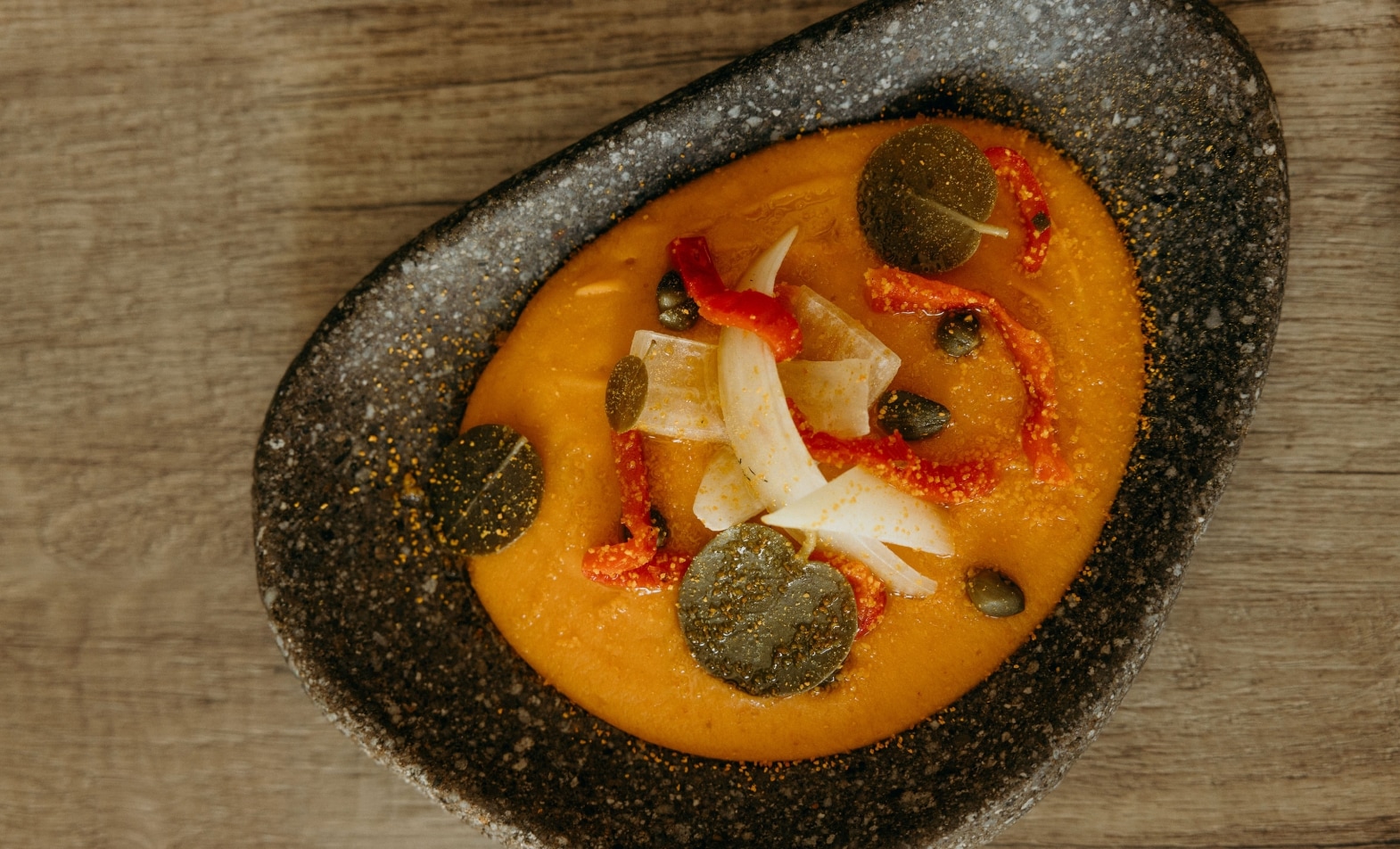
Order fava almost anywhere in Greece and you get a smooth yellow purée made from split peas. Order it here and the peas are not really peas at all. Santorini fava comes from Lathyrus clymenum, a relative of the grass pea that islanders call lathouri, and it has been farmed on this rock for more than 3,500 years. Archaeologists working at Akrotiri, the Bronze Age town buried under volcanic ash, found the very same seeds stored in clay jars. The European Union later granted it Protected Designation of Origin status, which ties the name to this small corner of the Cyclades and nowhere else.
The volcanic ground and the near-total lack of rain do something quiet to the flavour. The peas cook down fast into a soft, almost buttery cream with a natural sweetness, finished the old way with raw onion, capers, good olive oil and a squeeze of lemon. Cooperatives such as Santo Wines still mill it as they always have. We keep ours on the menu year round, and you will find it among our plant-based plates.
It is one of the most emblematic examples of traditional Greek food in Santorini, a dish shaped entirely by this island’s soil, its dry summers and its unbroken relationship with the land going back millennia.
Tomatokeftedes, Santorini Tomato Fritters
The Santorini cherry tomato, the tomataki, is grown almost without water. It lives on morning dew and the humidity that hangs in the night air, and that thirst is exactly what makes it remarkable. With so little water inside, the sugar concentrates, and the tiny fruit turns far sweeter and more intense than any tomato you would slice for a salad back home. It holds PDO status of its own.
Tomatokeftedes, tomato fritters, are what the island does with them. The grandmother’s version is rustic and honest: ripe tomato chopped by hand with onion and fresh mint, bound with a little flour, spooned into hot olive oil and fried until the edges go lacy and crisp. Modern kitchens lighten the batter and sometimes fold in herbs or a little chlorotyri, though the soul of the dish stays put. We make ours fresh through the season, and they sit among our vegan starters. For anyone curious about the original method, the Greek Gastronomy Guide keeps a faithful record of the island’s recipes.
The White Eggplant
Santorini’s white eggplant looks as though someone drained the colour out of an ordinary one. Pale ivory, smooth, and almost free of seeds, it is sweeter and milder than the purple kind, and it carries none of the bitterness that usually has cooks reaching for salt and a colander. It also soaks up far less oil in the pan, which is part of why the island fries it so happily. Like nearly everything grown here, it gets by on barely any irrigation.
You will meet it as a velvety melitzanosalata, sliced and fried as a starter, or layered into a local moussaka. It is one of the ingredients visitors are most surprised by, and we treat it with the plainness it asks for across our menu and vegan plates.
Chlorotyri, the Island’s Cheese
If you spot chlorotyri on a menu, order it before it runs out. This is Santorini’s own fresh cheese, soft and creamy with a clean, slightly sour edge, made from goat’s milk or a goat and sheep blend. Production is tiny and stays largely within the island’s kitchens and households, so it rarely travels off Santorini at all.
Traditionally it is spread thick on barley rusk or warm bread, or crumbled cold into a summer salad. It is the kind of thing you remember precisely because you cannot pick it up at home.
Capers and Caper Leaves
Look closely at the dry stone walls and the lip of the caldera and you will see the caper bush growing straight out of the rock, asking almost nothing to thrive. Santorinians have always foraged it. The buds become the sharp little capers most people recognise, but here the tender caper leaves are prized just as much, brined until they soften and turn intensely briny with a flavour that tastes of the sea itself.
A scattering over fava, a tomato salad or a plate of fish wakes the whole thing up, and lends the food that unmistakable Aegean salinity.
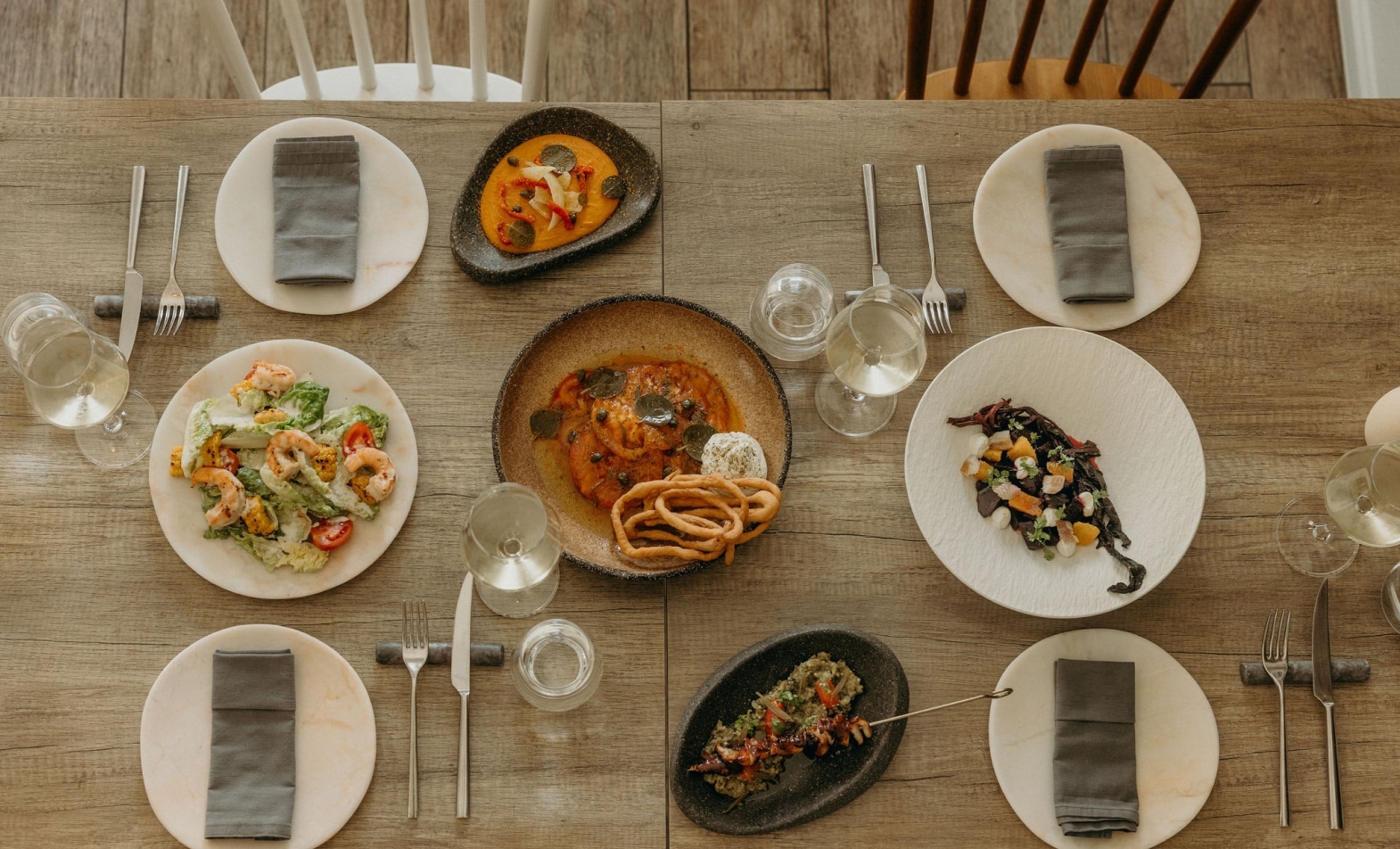

Fresh Fish from the Aegean
There is no secret list of fish to chase in Santorini. The honest answer is whatever the boats brought in that morning. Sea bream (tsipoura), sea bass (lavraki) and red mullet (barbouni) are the usual stars, with smaller fish set aside for frying. Ask what is fresh and trust the kitchen’s reply.
The cooking stays deliberately quiet. A whole fish goes over hot coals, comes off the moment it is ready, and arrives dressed with nothing more than ladolemono, the classic mix of olive oil, lemon and a little oregano whisked together at the table. No heavy sauce, because a fish this fresh does not want one. We follow the same approach with the daily catch on our seafood menu, and let the Aegean speak for itself.
Grilled Octopus
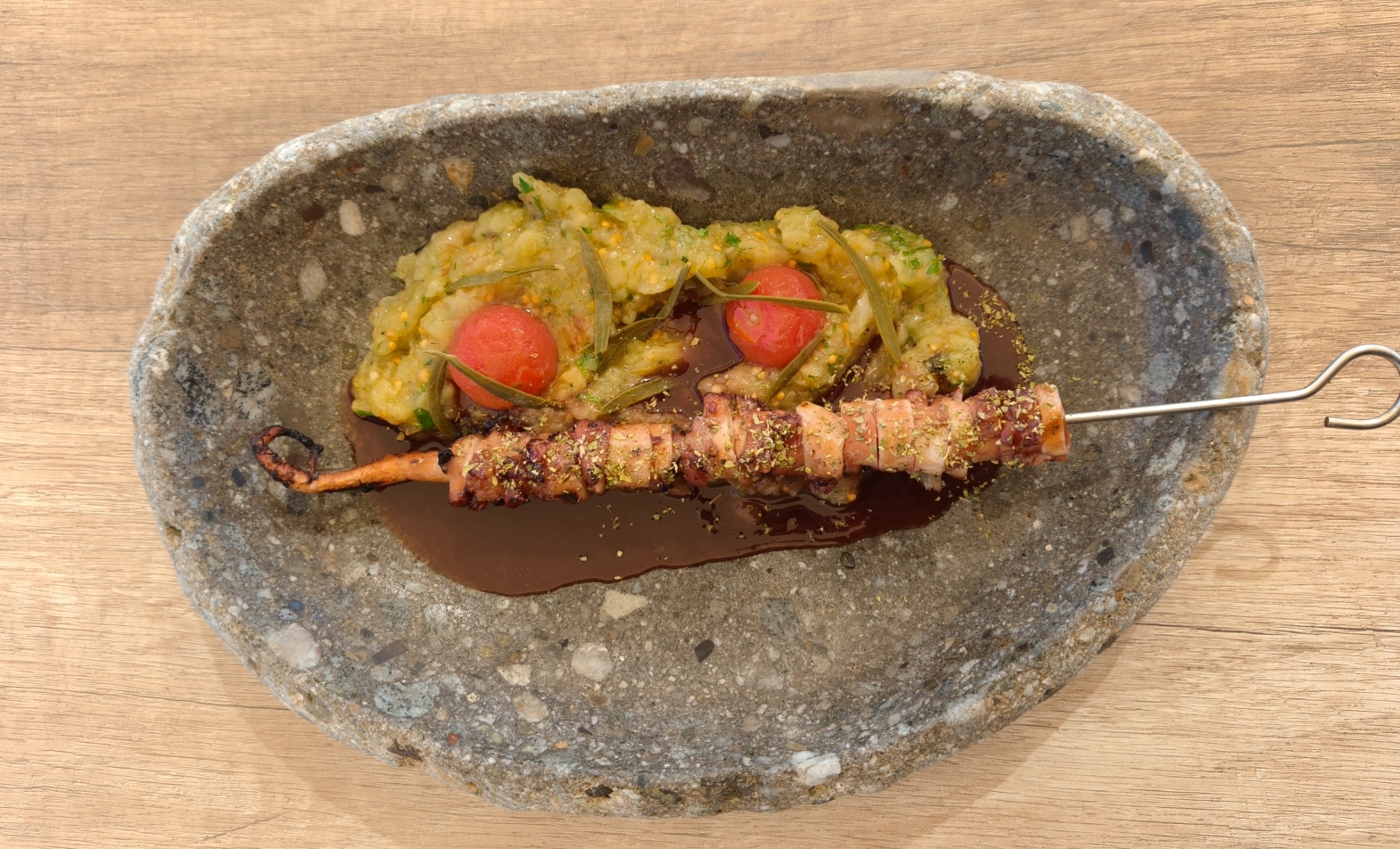
Few sights say Aegean summer quite like octopus hung out to dry on a line by the water, stiffening in the sun before it ever meets the fire. The drying is the trick: it deepens the flavour and helps the flesh turn tender rather than rubbery. Grilled over coals until the tips char and curl, then dressed with olive oil, a splash of vinegar and oregano, it comes out smoky, soft and faintly sweet. Locals reach for a glass of ouzo or a cold Assyrtiko alongside, and you should too. It belongs naturally beside the rest of our seafood plates.
The Santorini Salad and Its Katsouni
The island even has its own cucumber. The katsouni is shorter and firmer than the common kind, cooler on the palate, with fewer seeds, and for generations it was eaten straight off the vine like a piece of fruit.
It anchors the Santorini take on a summer salad: sweet tomataki, sliced katsouni, brined caper leaves, a handful of crumbled chlorotyri or a base of barley rusk in the style of a Cretan dakos, finished with olive oil. Bright, cool and built entirely from things grown within sight of the sea.
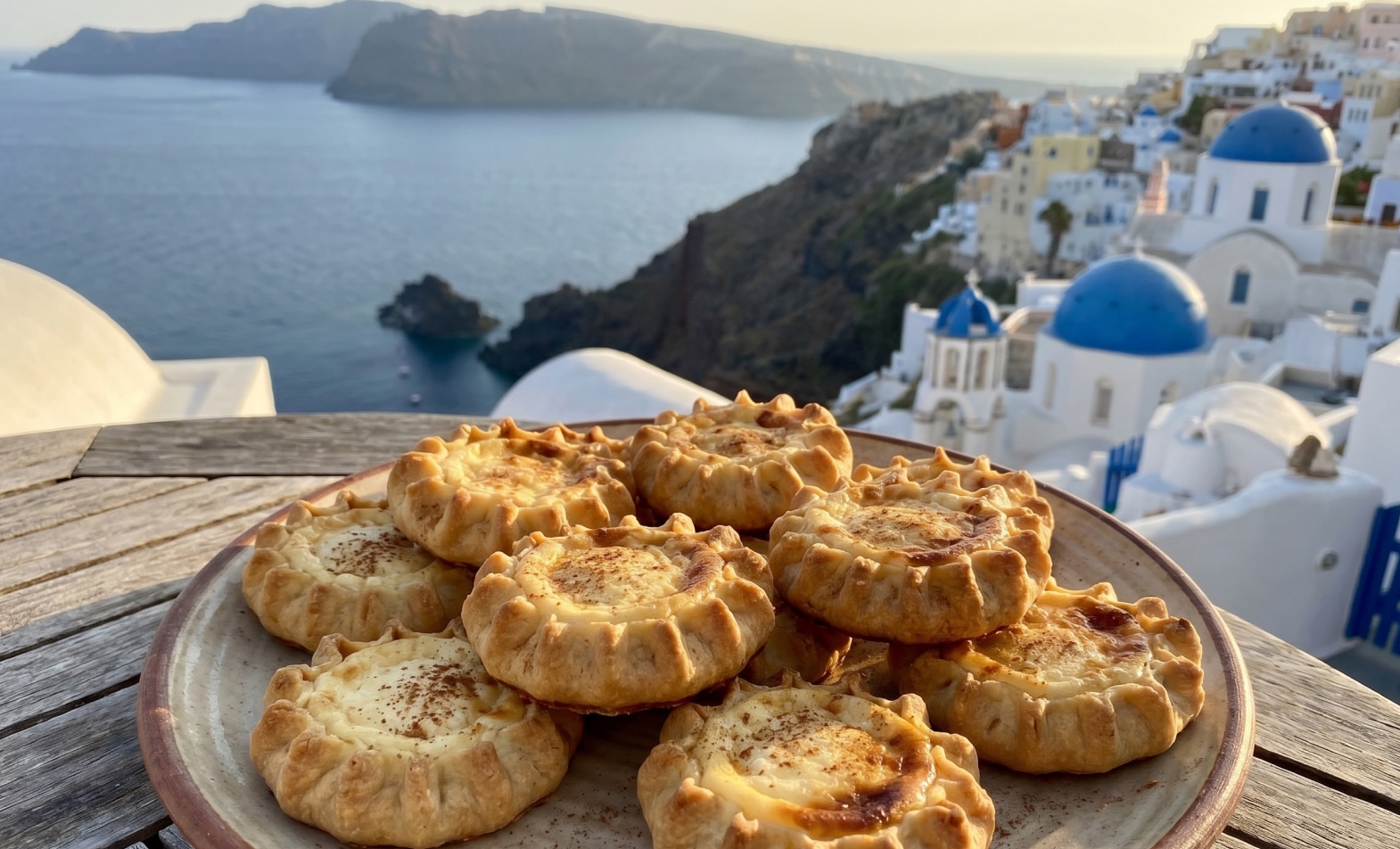

Melitinia, the Island’s Sweet Tartlets
Santorini has its own way of ending a meal. Melitinia are small sweet tartlets, the pastry pinched by hand into fine pleats around a filling of fresh local cheese, mizithra or anthotyro, scented with mastic and a little sugar. The name comes from an old Greek word meaning sweet as honey, and on the island they have been made for generations, above all at Easter and for weddings and celebrations.
Baked until the edges turn pale gold and the cheese sets soft inside, they sit somewhere between a cheesecake and a pastry, light and faintly fragrant rather than heavy. A drizzle of Santorinian honey or a dusting of cinnamon is all they need. We bring them out as a quiet, traditional close to a meal, the kind of sweet you will not find quite the same anywhere off the island.
Work your way through even half of this list and you will have tasted the island far more truly than any postcard could show you. Most of these plates sit on our main menu in one form or another, the Santorini fava, the white eggplant, the wood-fired octopus, the melitinia at the close, prepared the way they were meant to be eaten. When you are ready to taste them, find us in Oia and we will walk you through the rest.
If you are looking for authentic Greek cuisine in Oia, Santorini, Oia Gefsis serves all of these traditional dishes prepared the way they were meant to be eaten, with ingredients sourced from the island and recipes that have not been adjusted for passing trends. Come and find us when you are ready to eat well.